ADDING
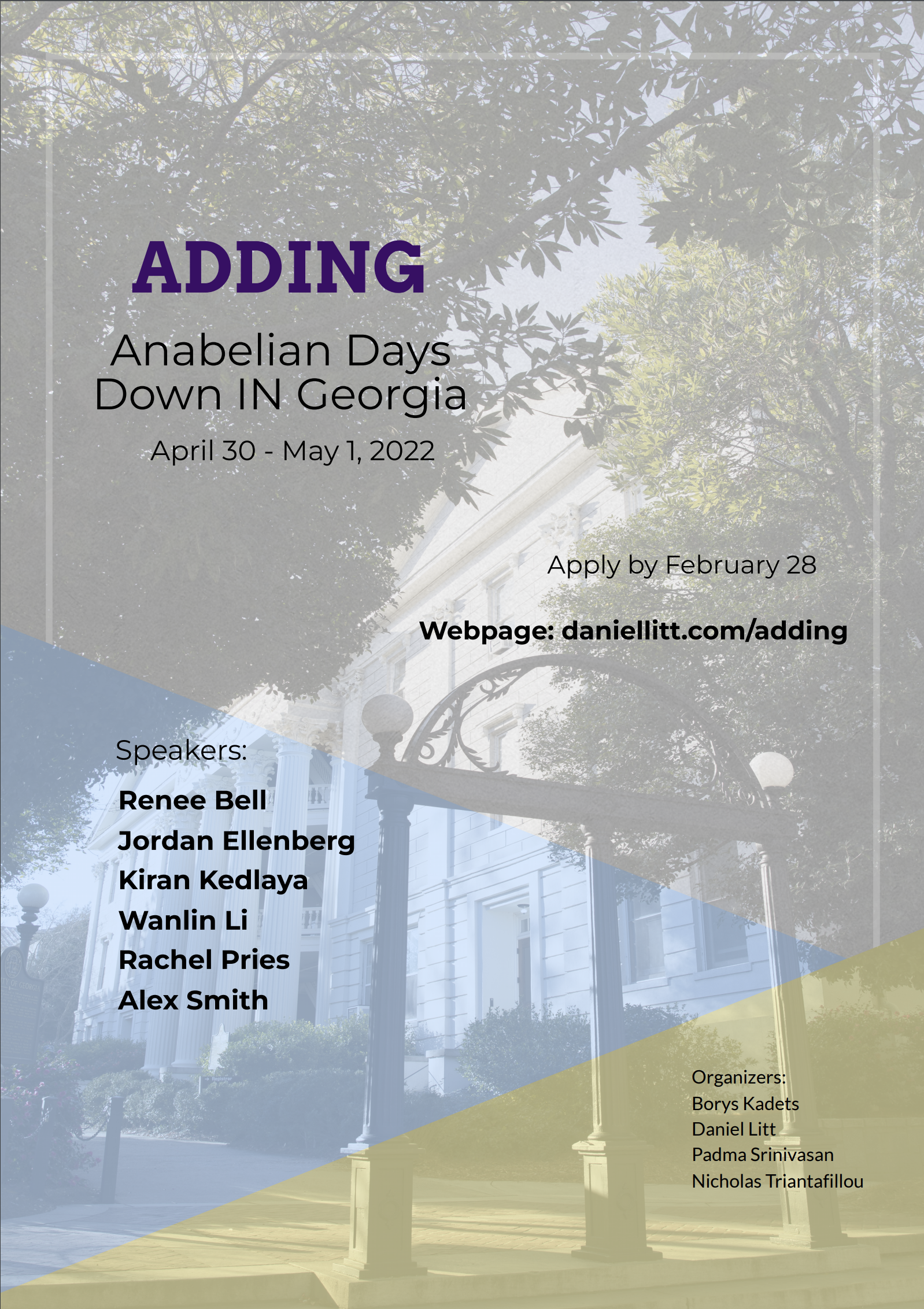
Welcome to the workshop page for ADDING: Anabelian Days Down IN Georgia. The workshop aims to bring together researchers from various areas around anabelian geometry, very broadly construed. The workshop will be held (tentatively in-person) on April 30 and May 1, on the UGA campus.
Register here — we have limited funds to support participant travel and hotel stays. If you’d like financial support, please apply by February 28. Please fill out the form even if you don’t require funding, so we have an idea of how many people will attend.
Schedule
All conference events will take place in Boyd 328 on the UGA campus.
Saturday
10 A.M. - 11 A.M. - Jordan Ellenberg
11:30 - 12:30 P.M. - Wanlin Li
2:30 - 3:30 P.M. - Problem session
4-5 P.M. - 5 contributed talks, 10 minutes each
Sunday
10 A.M. -- 11 A.M. - Rachel Pries
11:10 - 12:10 P.M. - Renee Bell
2:15 - 3:15 P.M. - Kiran Kedlaya
3:30-4:30 P.M. - Alex Smith
participants
Renee Bell*
Jordan Ellenberg*
Kiran Kedlaya*
Wanlin Li*
Rachel Pries*
Alex Smith*
* speaking
titles and abstracts
Speaker: Renee Bell
Title: Monodromy of Tamely Ramified Covers of Curves
Abstract: The étale fundamental group \(\pi_1^{\text{et}}\) in algebraic geometry formalizes an analogy between Galois theory and topology, extending our intuition to spaces in which loops, as defined traditionally, do not yield meaningful information. For a curve X over an algebraically closed field of characteristic 0, finite quotients of \(\pi_1^{\text{et}}\) can be described solely in topological terms, but in characteristic p, dramatic differences and new phenomena have inspired many conjectures, including Abhyankar's conjectures. Let k be an algebraically closed field of characteristic p and let X be the projective line over k with three points removed. In joint work with Booher, Chen, and Liu, we show that for each prime p ≥ 5, there are families of tamely ramified covers with monodromy the symmetric group S_n or alternating group A_n for infinitely many n, producing these covers from moduli spaces of elliptic curves, and relating the fiber of these covers to the Markoff surface.
Speaker: Jordan Ellenberg
Title: Sparsity of rational points on moduli spaces
Abstract: (joint with Brian Lawrence and Akshay Venkatesh) One expects, speaking vaguely, that, among varieties of a certain type over Q, there are only finitely many with good reduction away from a specified set S. Such statements are often called “Shafarevich conjectures” -- when the varieties are abelian varieties, this actually was conjectured by Shafarevich, and is no longer a conjecture. We do not know how to prove this. But we do prove that, in some degree of generality, the ones with good reduction away from S are sparse, in the sense that the number of such with height less than B grows more slowly than any power of B. The key tool is the use of theorems of Heath-Brown type which provide bounds on points of bounded height on varieties which are uniform in the variety. One way to summarize what we prove is that varieties with large fundamental group have sparse integral points (which conforms with a story we know very well for curves.) In the anabelian spirit, I will explain how the whole story can be thought of in terms of low-height points repelling each other in the profinite topology afforded by thinking of points as Galois-theoretic sections.
Speaker: Kiran Kedlaya
Title: Crystalline companions as an anabelian phenomenon
Abstract: Let X be a smooth variety over a finite field with etale fundamental group G. It is a general question of anabelian geometry to deduce geometric properties of X from group-theoretic properties of G. We formulate the theory of crystalline companions as an example of this question, focusing on some concrete results.
Speaker: Wanlin Li
Title: Ceresa cycle and hyperellipticity
Abstract: The Ceresa cycle is an algebraic cycle associated to curves that is algebraically trivial for hyperelliptic curves and non-trivial for a very general non-hyperelliptic curve. Via cycle class maps, the Ceresa cycle gives rise to various cohomology classes. In this talk, we will discuss the relation between the vanishing of these Ceresa classes and hyperellipticity. The talk is based on joint work with Bisogno--Litt--Srinivasan, Corey--Ellenberg and ongoing work with Corey.
Speaker: Rachel Pries
Title: The classifying element for cyclic covers of the projective line branched at 3 points
Abstract: Suppose \(X/\mathbb{Q}\) is a cyclic cover of the projective line branched at \(\{0,1, \infty\}\). In this talk, I will discuss a result with Duque-Rosero about the classifying element of \(X\); this element determines the cup product map and also determines the lower central series of the fundamental group of \(X\). Building on earlier work, I will explain how this gives information about the action of the absolute Galois group \(G_{\mathbb{Q}}\) on the étale fundamental group \(\pi_1(X)\).
Speaker: Alex Smith
Title: Simple abelian varieties over finite fields with extreme point counts
Abstract: Given a compactly supported probability measure on the reals, we will give a necessary and sufficient condition for there to be a sequence of totally real algebraic integers whose distribution of conjugates approaches the measure. We use this result to prove that there are infinitely many totally positive algebraic integers X satisfying tr(X)/deg(X) < 1.899; previously, there were only known to be infinitely many such integers satisfying tr(X)/deg(X) < 2. We also will explain how our method can be used in the search for simple abelian varieties with extreme point counts.
short contributed talks
Speaker: Oana Adascalitei
Title: Finding \(\mathbb{Q}(\sqrt{-5})\)-rational points on \(X_0(N)\) for certain levels of \(N\)
Abstract: Following the footsteps of B. Mazur and M. A. Kenku who determined the cyclic isogeny degrees over \(K = \mathbb{Q}\), a natural question to ask is whether their work can be generalized to allow \(K\) to be a quadratic number field. In this talk we look at what we know about \(K = \mathbb{Q}(\sqrt{-5})\). This is joint work in progress with Barinder Banwait and Filip Najman.
Speaker: Alex Betts
Title: A partial finiteness result for the Selmer section set
Abstract: Let Y be a curve over a number field K. Is the set of splittings of the fundamental exact sequence for Y/K finite? In this talk, I will preview an upcoming result with Jakob Stix in which we prove a weak finiteness result in this direction, unconditionally and for a general curve Y over certain number fields K.
Speaker: Daniel Hast
Title: Rational points, unipotent fundamental groups, and the non-abelian Chabauty method
Abstract: The non-abelian Chabauty method gives information about rational points on certain anabelian varieties (mainly hyperbolic curves), using various unipotent fundamental groups to construct p-adic analytic functions whose zero locus contains all rational points. We will briefly survey some recent developments and applications of the method.
Speaker: Asvin G
Title: The variation of Frobenius eigenvalues in \(\ell\)-adic towers of curves over a finite field
Abstract: The action of the Frobenius on the \(\ell\)-adic cohomology of a variety over a finite field is an interesting invariant of the variety. By the Weil conjectures, the absolute values of the eigenvalues are well understood but this is not the complete story. We study the \(\ell\)-adic properties of these eigenvalues by taking inspiration from Iwasawa theory. We consider towers of curves such as \(y^2 = f(x^{\ell^n})\) over a finite field and prove that the characteristic polynomials of the Frobenius converge in an appropriate sense.
Speaker: Tian Wang
Title: Frobenius trace distribution for abelian varieties
Abstract: Let A be a principally polarized abelian variety of dimension g defined over Q. For an integer t and a positive number x, let \(\pi_A(x, t)\) be the number of primes p up to x, of good reduction for the abelian variety A, for which the Frobenius trace associated to the reduction of A modulo p equals t. Based on prior work on the Lang-Trotter Conjecture for a non-CM elliptic curve, we proved, under GRH, a non-trivial upper bound for \(\pi_A(x, t)\), when A is either isogenous to g product of non-CM, non-isogenous elliptic curves or A has a trivial endomorphism ring. In both cases, our results generalize the best known upper bound for g=1 and improve upon the current record for g>=2. This is joint work with Alina Carmen Cojocaru.
organizers
Borys Kadets, Daniel Litt, Padma Srinivasan, Nicholas Triantafillou
travel and hotel information
The University of Georgia is in Athens, GA — the nearest major airport is in Atlanta, GA. We suggest booking a Groome Shuttle to get from the Atlanta airport to Athens, or sharing an Uber, Lyft, or other ridesharing service with other conference attendees.
We have a block of rooms available at the Athens downtown Hyatt, 4/30-5/2, for \($124\) per night plus tax, with an additional \($10\) fee for parking; this block will be available until March 30. You can book online using the group code G-KAM2. There are also a number of other affordable hotels in the area. We also have a room block at the Holiday Inn Express, where you can reserve a room for \($104\) per night plus tax, with an additional \($5\) fee for parking, by calling the hotel at 706-546-8122 and referencing the ADDING workshop. We cannot reimburse for stays at AirBnB or Vrbo.
There is a fair amount of parking on campus, most of which is free on weekends. See here for detailed information. We recommend parking in one of the South Campus lots; S04 and S05 are closest to Boyd, where the conference will take place, but there are numerous street-level parking lots. There are also a few parking decks, the closest of which to Boyd is the South Campus Deck, but this requires a fee to park.
poster
Download the .pdf here